Tracking wolves in winter is one of the most revealing and rewarding wildlife skills. Snow preserves detail and wolves are often more active as they hunt across wide territories. This manual provides practical guidance for identifying, interpreting, and safely following wolf sign in winter conditions.
1. Understanding the Animal You’re Tracking
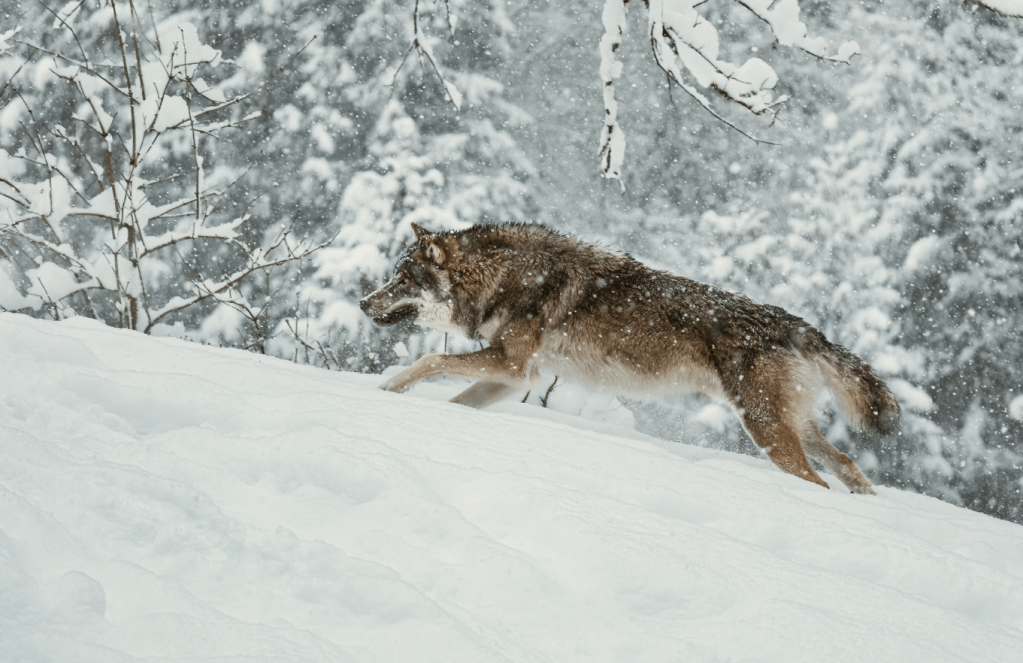
The most widespread wolf species in Europe is the Gray Wolf (Canis lupus). In winter, wolves:
- Travel long distances (10–30+ miles per day)
- Hunt large ungulates such as deer, pigs and chamois
- Move in coordinated packs with defined hierarchy
- Use established trails, frozen waterways, and ridgelines
Winter tracking often reveals pack structure, hunting strategies, and territorial behavior.
2. Essential Winter Tracking Equipment
Clothing & Safety
- Insulated, waterproof boots
- Snowshoes or backcountry skis
- Layered clothing (avoid cotton)
- Map, compass, and GPS
Tracking Tools
- Camera or smartphone
- Binoculars
- Track identification guide
3. Identifying Wolf Tracks in Snow
A. Track Size and Shape
Wolf tracks are:
- 10–13 cm long
- Slightly longer than wide
- Oval-shaped
- Four toes with visible claw marks
Key Characteristics
- Toes are tight and symmetrical
- The front two toes often align evenly
- The heel pad is large with a single lobe at the top and two at the bottom
B. Distinguishing from Dogs and Coyotes
Compare to the Coyote:
| Feature | Wolf |
|---|---|
| Length | 10–13 cm long |
| Gait | Purposeful, straight line |
| Toe Spread | Tight |
Domestic dogs often:
- Meander
- Have splayed toes
- Show inconsistent stride
A wolf pack trail often appears as a single-file line, with individuals stepping in each other’s tracks to conserve energy.
4. Gait Patterns in Winter
Wolves primarily use:
- Walk – Most common; direct register (hind foot lands in front track)
- Trot – Efficient long-distance travel
- Lope/Run – During hunts or play
Stride Length
- Walking stride: 26–32 inches
- Trotting stride: 40+ inches
Straight-line travel is a strong wolf indicator.
5. Reading the Story in the Snow
Winter snow acts like a narrative surface. Learn to interpret:
A. Pack Size
Count track sets when they spread out:
- Look at turns or obstacles
- Identify size differences (adults vs. juveniles)
B. Hunting Activity
Signs of a hunt:
- Sudden direction changes
- Deep plunge marks (lunging)
- Blood spots or disturbed snow
- Ungulate tracks (e.g., deer or elk)
Wolves in National Parks in Slovakia have been extensively studied for winter hunting behavior, offering valuable case examples for trackers.
C. Territorial Marking
Look for:
- Urine marks on raised objects
- Scat placed prominently on trails
- Scratch marks in snow
Scat often contains: The hair is immediately visible in the scat, if you look inside you discover larger bone fragments. If you compare with similar scat of a fox the differences are obvious: the scat of a wolf is 10-15 cm long, scat of a fox just 10 cm long and scat of a fox contains hair and only small bones from small prey like rodents.
- Hair
- Bone fragments
- Hoof pieces
6. Aging Tracks in Winter
Determine freshness by examining:
Edges
- Sharp = recent (within hours)
- Rounded = older
Snowfall
- Tracks filled in = pre-storm
- Crisp with powder inside = post-storm
Temperature
- Melt-freeze crust indicates daytime thaw and nighttime freeze
- Wind drift softens edges quickly
Fresh wolf tracks may still radiate subtle warmth in very cold conditions (detectable by touch).
7. Tracking Strategy
Step-by-Step
- Locate a known travel corridor (ridge, frozen river, foothills of the mountains). The wolves often use ridges that allow them to change valleys in winter. Another good spot is waiting along rivers in winter period where most of the wildlife is situated in winter. The best places can be favourite deer resting places close to the mountains, as many animals spend their winters at the foothills of the mountains.
- Identify a promising track set.
- Confirm species through size and gait.
- Move parallel rather than directly in the track line to preserve sign.
- Observe ahead frequently — wolves may not be far.
Avoid pushing directly behind fresh tracks; wolves can detect pursuit.
8. Safety Considerations
- Wolves rarely attack humans, but maintain distance.
- Never approach a fresh kill site.
- Be aware of other predators (e.g., bears)
 Wolf Tracking